What Can a Fuel Card Do for Vehicle Fleet Management?
A fuel card can help a fleet manager organize fuel purchases, set spending controls, reconcile expenses, and turn transaction records into useful reports. Its value extends beyond the payment itself: a manager can connect who bought fuel, which vehicle or department incurred the cost, and what needs attention afterward.
The strongest results come from a defined process. Drivers need workable fueling options, accounting needs complete records, and the fleet manager needs measures that support decisions. Evaluate the card against those tasks, then measure whether it reduces costs or administrative effort.
Connect fuel purchasing with day-to-day fleet operations
Business Fleet Solutions describes Shell fleet-card options with purchase limits, driver IDs, online card activation and suspension, and fueling reports. Its homepage advertises rebates of up to six cents per gallon, plus access to more than 12,000 Shell stations or a card option accepted at 95% of U.S. fueling stations. These are provider-advertised capabilities across its offerings; confirm the selected product’s terms, acceptance, eligible purchases, and fees before budgeting a benefit.[1]
Use the available capabilities to define a workflow from purchase authorization to management review. The proposed workflow below identifies responsibilities; it does not imply that every step happens automatically.
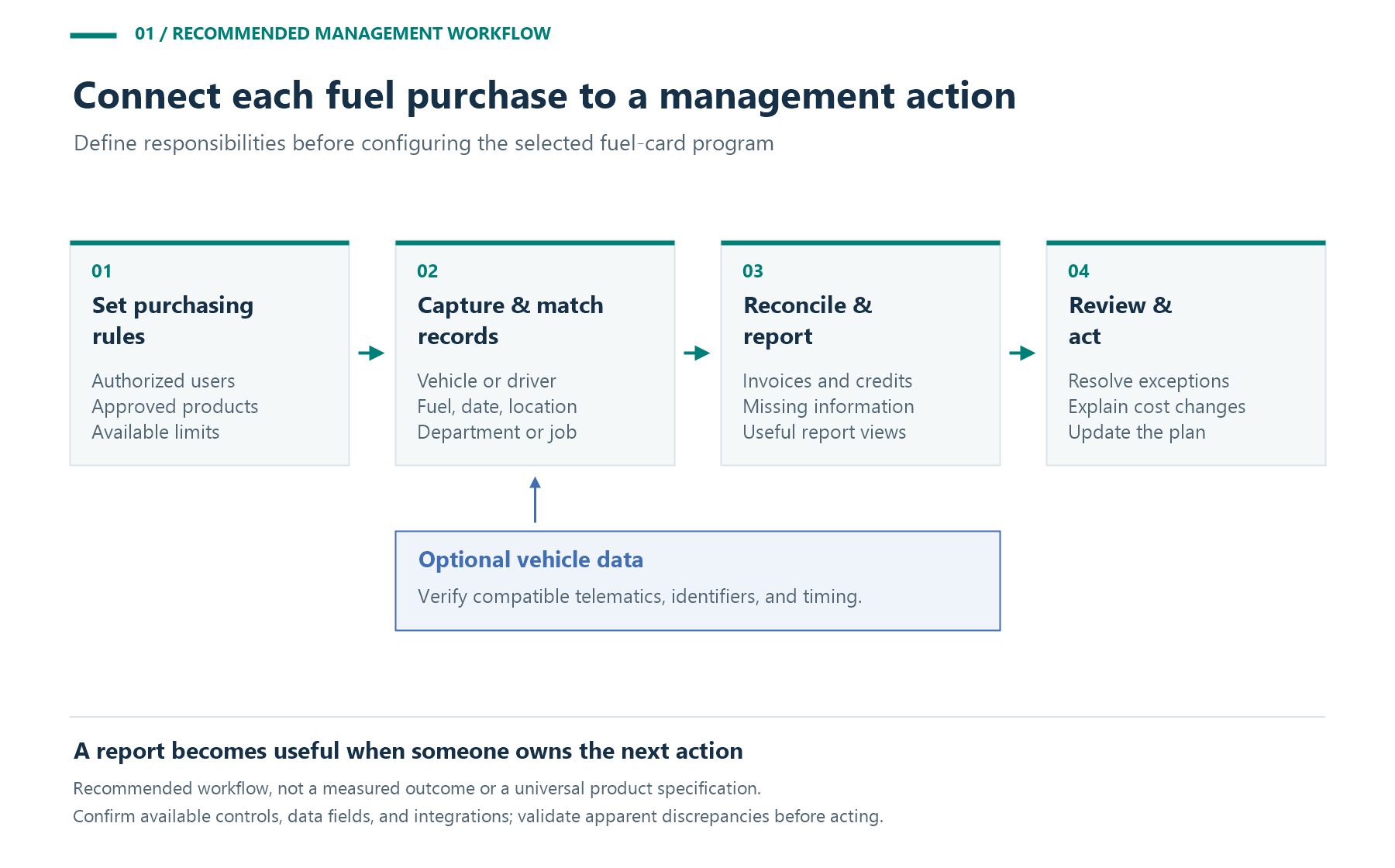
| Fleet-management task | What to ask the provider to demonstrate | What the fleet still needs to do |
|---|---|---|
| Authorize purchases | Available product, amount, and timing controls | Set practical rules and an emergency procedure |
| Assign costs | Transaction fields, driver identifiers, and vehicle mappings | Maintain correct assignments and cost centers |
| Reconcile spending | Invoices, credits, and exportable transaction records | Match totals and resolve discrepancies |
| Review performance | Reports and exception views | Investigate causes and document actions |
| Connect vehicle data | Supported integrations and required inputs | Verify compatibility and data accuracy |
This is a recommended evaluation framework. Test it with a real purchase, a declined purchase, a missing credit, and a reassigned vehicle before extending the program across the fleet.
Control what drivers can purchase
Translate the fuel policy into the settings the selected program supports. Align available limits with vehicle tank capacity, approved gasoline or diesel, normal working patterns, and legitimate emergency needs. Have drivers test the process before relying on it during a busy shift.
Decide whether cards follow vehicles or individual drivers, and keep the assignments current. Identify who can change limits, suspend a lost card, and approve an exception. Review access when a driver leaves or a vehicle is reassigned.
Treat an unusual transaction as a starting point for investigation. Check the receipt, job assignment, timing, and explanation before deciding whether a rule was broken. A declined purchase or alert is not a verified fraud saving; count avoided or recovered expense only when the circumstances and amount are supported.
Reduce fuel costs by comparing the final purchase price
Start with the gallons that actually qualify for an earned rebate:
Gross fuel rebate = eligible gallons × earned rebate per gallon.
Consider a hypothetical 25-vehicle fleet purchasing 60,000 gallons annually. If 80% qualify for a constant four-cent rebate, gross rebates equal $1,920 per year: 60,000 × 80% × $0.04. The effective rebate across all purchased gallons is 3.2 cents per gallon. These inputs are assumptions, not a quote for a particular card.
Compare station prices after applicable credits. A hypothetical $3.60 pump price less a five-cent rebate leaves $3.55 per gallon. Another suitable accepting station charging $3.50 without that rebate is still cheaper. A 25-gallon purchase would cost $1.25 less at the second station.
Check coverage along actual routes, including fuel type, opening hours, and vehicle access. Include the additional fuel, driver time, or other expense of a detour. Card acceptance, rebate eligibility, and operational suitability should each pass a separate check.
If rates depend on billing-cycle volume, calculate each cycle under the applicable terms. Deduct rewards the fleet would lose by changing payment methods, and include all incremental program charges. Report the net purchasing result rather than applying an advertised maximum to every gallon.
Make fuel accounting and report generation more useful
GSA SmartPay’s fleet guidance describes account-activity and exception reports, detailed electronic files for financial systems, invoice-status reports, and dispute tracking. It says most electronic reports update within two to three days after a transaction, while some update at the billing-cycle close. That is a federal-program example; commercial platforms may have different features and timing.[2]
Request a sample export containing the fields needed by the fleet’s accounting system. Check how purchases, credits, refunds, and fees appear. Confirm when final transactions become available and how corrections affect previously downloaded reports.
A useful monthly report should lead to a defined action:
| Report | Suggested measure | Management action |
|---|---|---|
| Fuel spending by vehicle | Gallons and net fuel dollars for comparable work | Investigate changes in price, activity, or consumption |
| Station purchasing | Gallons-weighted price by fuel grade and location | Review approved fueling choices |
| Rebate reconciliation | Expected credits compared with posted credits | Resolve missing or incorrect credits |
| Purchase exceptions | Unusual transactions and their resolution status | Assign and complete the review |
| Department or job allocation | Fuel expense matched to a cost center | Improve budgeting and cost allocation |
| Administrative workload | Handling minutes and correction volume | Verify whether the complete process saves time |
These are recommended management views, not a promise that every platform generates them automatically. Assign an owner and review schedule to each one. A report becomes useful when someone can explain the change it shows and decide what to do next.
Measure the time saved across the complete process
Suppose the fleet processes 250 fuel transactions per month. Reducing average handling time from five minutes to two minutes would recover:
250 × (5 − 2) ÷ 60 = 12.5 hours per month.
That equals 150 hours annually. At an assumed $40 per hour, the recovered time has a $6,000 annual staff-capacity value. All of these inputs are hypothetical and must be tested in the fleet’s own workflow.
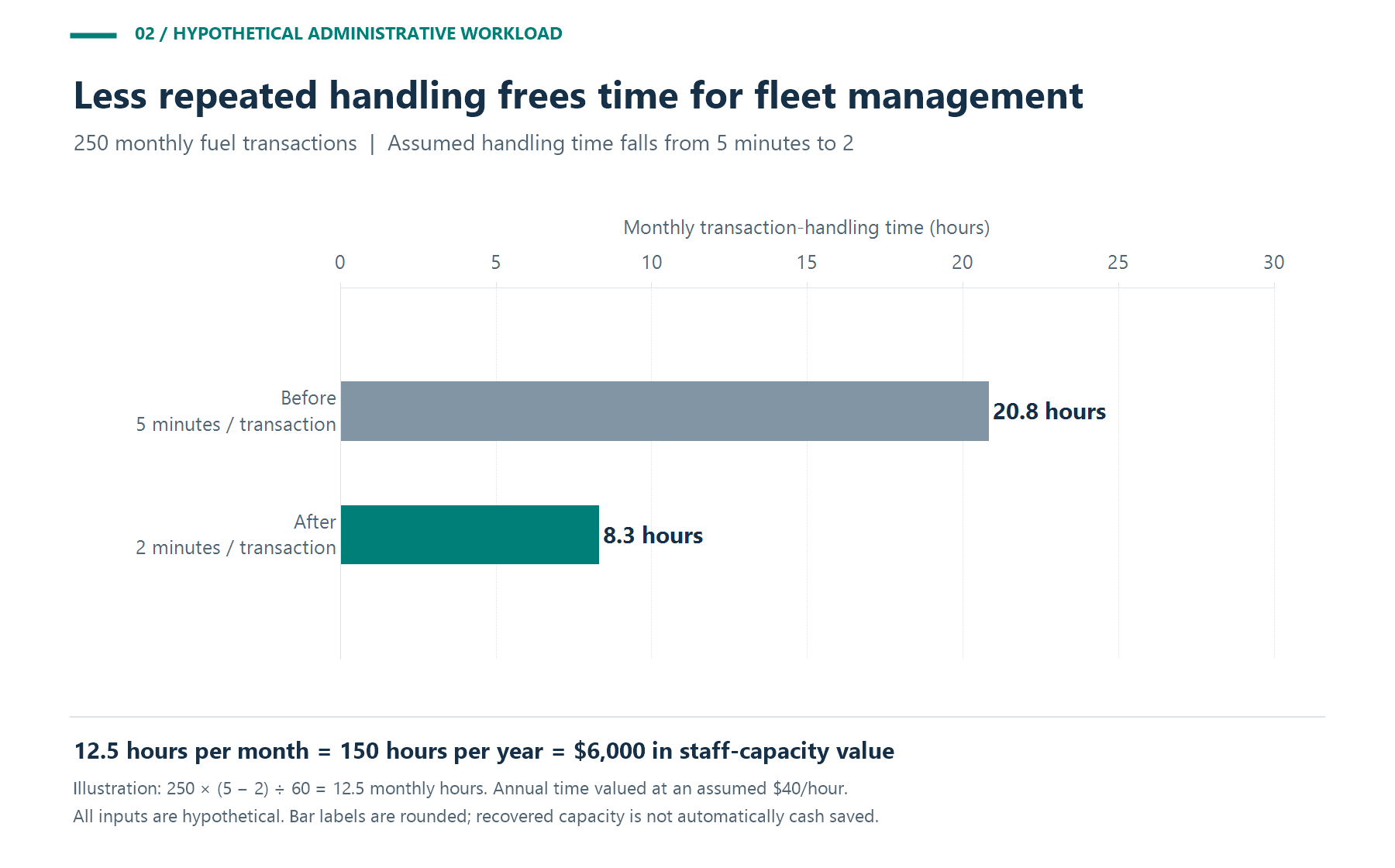
Include card administration, missing-record follow-up, invoice matching, credit checks, and exception reviews in the timing exercise. Recovered hours create additional capacity; they reduce cash expense only if paid overtime, outsourced work, or another actual cost falls. Avoid counting the same hours as both payroll savings and additional productive time.
Build reliable vehicle and driver records
DOE’s FleetDASH methodology describes fuel-card records containing vehicle fuel type, purchased fuel, date, station location, quantity, and organizational assignment. It also documents delayed or missing purchases, miscoded fuel types, inaccurate locations, and incorrect vehicle information. This federal dataset illustrates why transaction records need validation before they support decisions about a vehicle, department, or driver.[3]
Set up a consistent vehicle identifier and verify it in sample transactions. Check driver assignments, units, credits, and off-card purchases. Reconcile the fuel totals to the invoice before using a dashboard to compare crews or vehicles.
Keep purchase price and consumption as separate measures. A higher bill may reflect a different operating area, greater workload, or a changed purchase mix. Use a gallons-weighted average price and compare vehicles doing similar work before attributing the difference to fuel efficiency.
When calculating miles per gallon, verify that the mileage and fuel quantity describe a compatible interval. Account for incomplete records and differences in fuel remaining in the tank. A partial set of purchases should not be treated as a complete measurement of vehicle consumption.
Add telematics context where the card record is insufficient
Geotab’s Fuel Transactions documentation describes matching purchases to assets or drivers and identifying location, tank-size, and fuel-type mismatches using vehicle telemetry. It emphasizes consistent vehicle identifiers and driver assignments, and notes that some fuel-card products are unsupported by standard integrations. These are documented MyGeotab functions, not capabilities automatically included with every fuel card or confirmed compatibility with the provider above.[4]
For fleet-management decisions, distinguish the evidence supplied by each system. A transaction record identifies a purchase. GPS and vehicle telemetry provide separate information that may help assess where the assigned vehicle was or whether the purchase fits its recorded specifications.
Before connecting systems, request a demonstration using the exact card product, vehicle setup, and software subscription the fleet would use. Test a normal purchase, a missing assignment, and an apparent mismatch. Confirm how records are matched, what happens when information arrives late, and whether correcting an assignment updates historical reports.
An integration can make a discrepancy easier to investigate. It does not remove the need to check timestamps, vehicle records, and the driver’s explanation before drawing a conclusion.
Separate purchasing support from the wider fleet-management job
Use the fuel-card program for the tasks it demonstrates successfully. Evaluate separate operational requirements—such as dispatch, continuous vehicle location, maintenance scheduling, and vehicle-use documentation—on their own evidence and system capabilities.
For example, an unexpected fuel-cost trend can justify checking a vehicle’s workload, records, and condition. Record the finding and any maintenance or operating change before assigning a saving to it. The improvement should be tied to the action taken, with other changes in prices and workload accounted for.
Keep an exception log with a responsible person, supporting evidence, outcome, and follow-up date. This gives the fleet manager a repeatable way to turn a flagged purchase or unusual trend into a resolved issue.
Calculate the benefit after fees and implementation costs
The hypothetical first-year example below combines the earlier 25-vehicle fuel and time assumptions. It assumes unchanged pump prices, routes, and fuel consumption, and no rewards under the current payment method. Every charge is illustrative.
| First-year item | Calculation | Annual value |
|---|---|---|
| Gross fuel rebates | 60,000 gallons × 80% eligibility × $0.04 | $1,920 |
| Card fees | 25 cards × $2 per month × 12 | −$600 |
| Reporting charges | $20 per month × 12 | −$240 |
| Setup and training | Assumed one-time cost | −$300 |
| Net cash benefit | $1,920 − $1,140 | $780 |
| Recovered staff-capacity value | 12.5 hours per month × 12 × $40 | $6,000 |
| Total economic value | $780 + $6,000 | $6,780 |
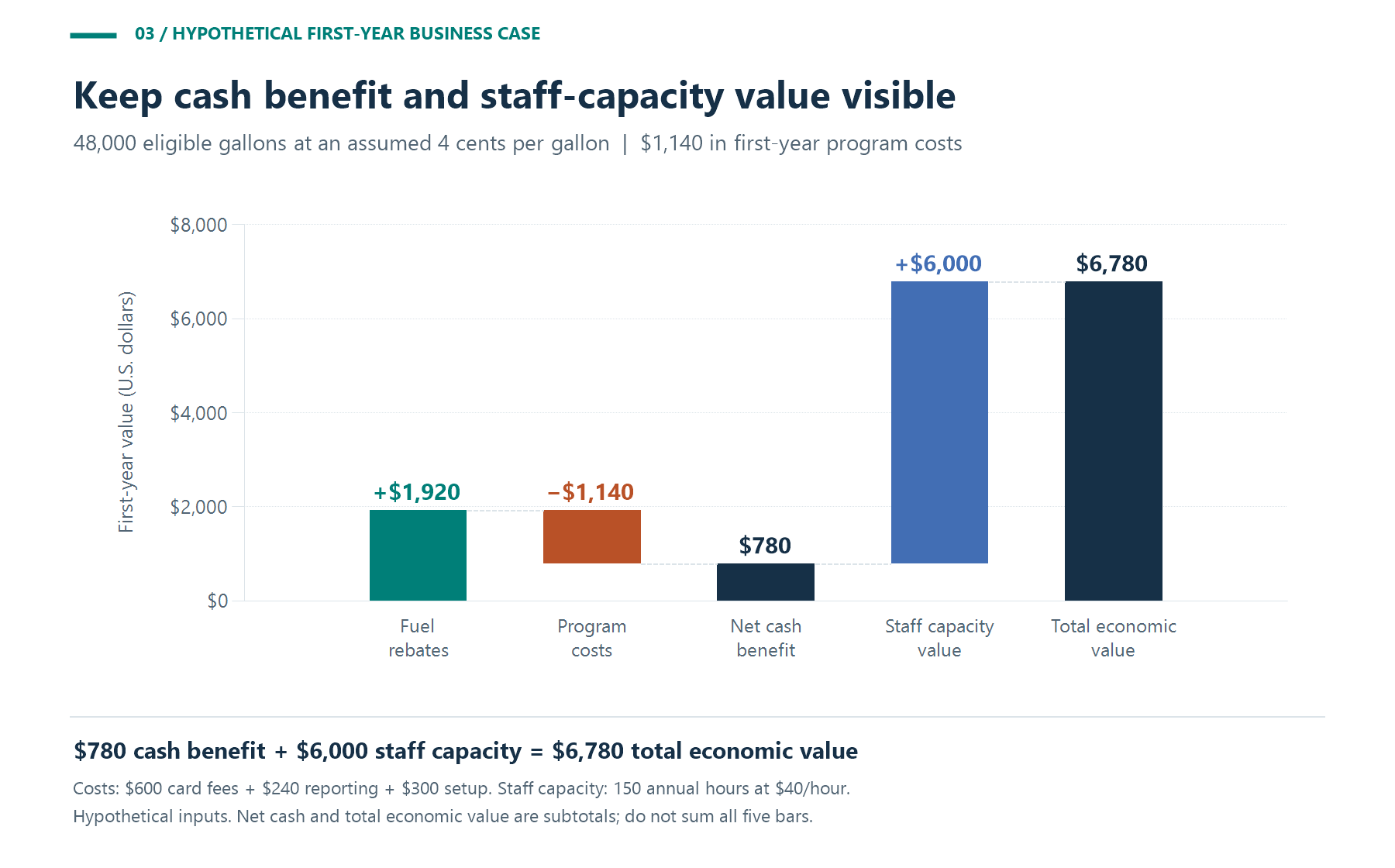
The $6,780 total includes staff capacity; the modeled cash benefit is $780. No unmeasured benefit is assigned to fraud prevention, driver behavior, reporting decisions, or coverage. The case includes no assumed telematics benefit or cost; add any incremental integration, hardware, subscription, financing, or transaction charges required by the chosen setup.
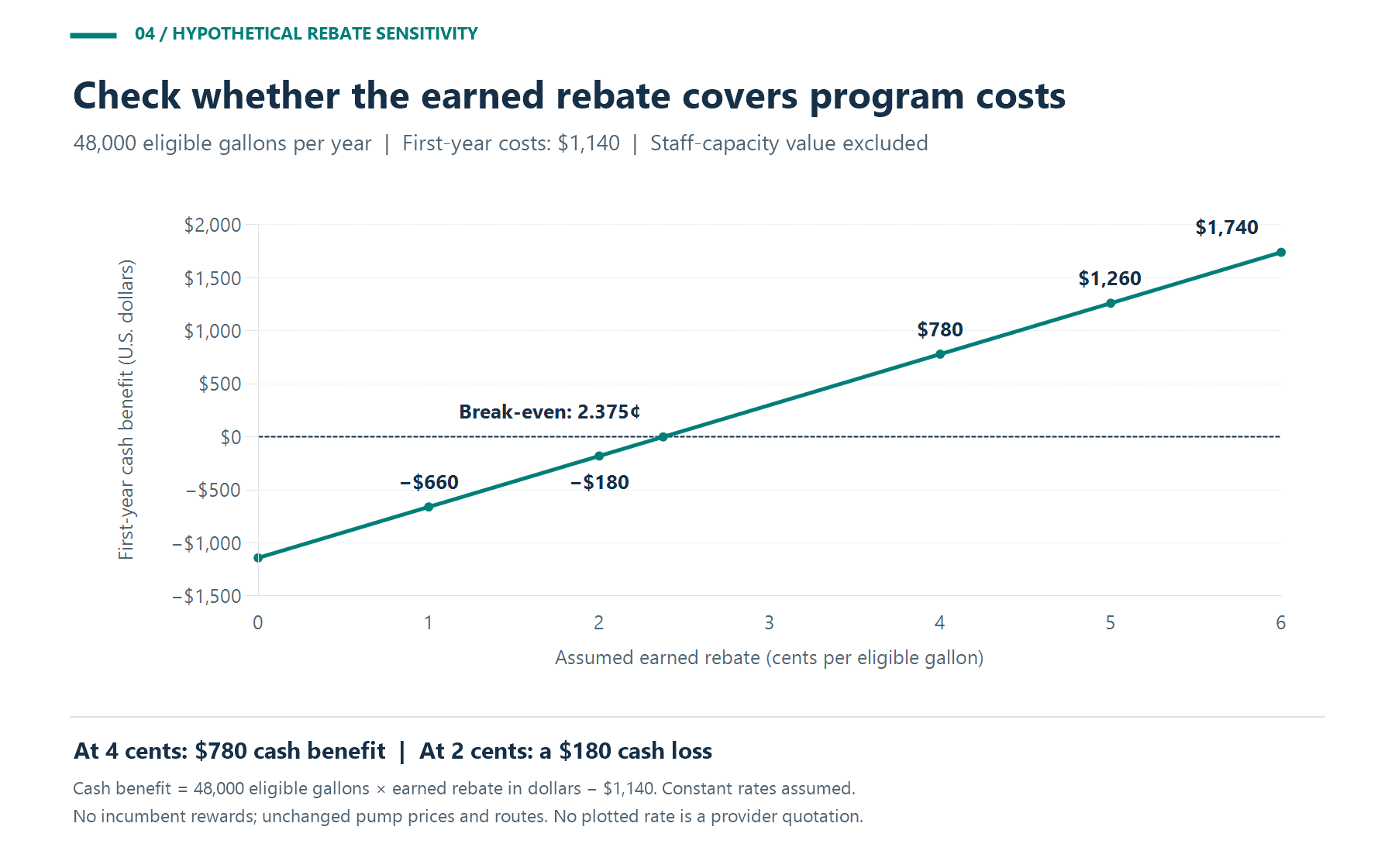
Test sensitivity before committing. With 48,000 eligible gallons and $1,140 in first-year costs, the rebate-only break-even rate is 2.375 cents per eligible gallon. At a two-cent rate, gross rebates would total $960 and the cash result would be negative $180.
Start with a pilot that the fleet can evaluate
Choose representative vehicles, drivers, routes, and accounting tasks. Record the current process first, then compare the proposed program over similar work. Agree in advance on the coverage, cost, reporting, and administrative outcomes needed to justify expansion.
Track eligible gallons, final prices, posted credits, incremental fees, handling time, missing records, and resolved exceptions. Confirm that the data can be explained and that someone owns the recurring review work.
A fuel card contributes to vehicle fleet management when purchasing controls and transaction records lead to verifiable results: lower net expense, less repetitive administration, clearer accountability, and better-informed decisions about daily operations.